
Search the website

-
Dates
Sundays during term time
-
Specific Timings Below
Between 9:30 AM – 1 PM
-
Fees (per term)
£66–£154 dependent on age.
-
Autumn Term Bursary Application 2026
DISCOVER OUR AUTUMN TERM THEME
Who’s it for?
On Sundays during term time, we are open to young people from across the South West. Catering for children aged 3-17, Sunday Young Artists provides weekly classes in performance and production skills taught by professionals (with support from our full-time degree students at the height of their training.)
Young Artists at Bristol Old Vic Theatre School
Young Artists is a space where children and young people are recognised and trusted as creative artists. Here, they are encouraged to think independently, take creative risks, and collaborate to build original theatre from the ground up. Each group works together over a ten-week term, culminating in a Week 10 sharing, an exciting opportunity where students proudly show the work they have created themselves to invited friends and family.
We offer classes for the following age groups
- Wings – age 3-4
- Upstage – age 5-6
- Downstage – age 7-9
- Centre Stage – age 10-12
- Stage Left – age 13-14
- Stage Right – age 15-17
Why Young Artists?
Young Artists is a long-term creative pathway for children and young people aged 3–18, designed by Bristol Old Vic Theatre School. Through theatre-making, students grow confidence, communication, and collaboration skills while discovering their own voice. With expert guidance and a welcoming, inclusive culture, every term gives children the chance to try, experiment, and perform, learning skills that extend well beyond the stage.
Young Artists provides the best possible introduction to the “culture” of theatre. Enabling participants to explore collaboration across disciplines, discovering what is needed to make productions possible.
There is no leading role, but an ensemble of young artists that realises each piece of work together.
Students will gain an understanding of the variety of job roles in professional theatre and the importance of team work, communication skills and innovative thinking.
Term structure
Every term focuses on a theme, with exercises and activities structured around it.
Students will explore performance skills, costume and set design, as well as different roles within theatre making such as directing and stage management.
At the end of the term we invite family and friends to come and share in the work they’ve explored and created.
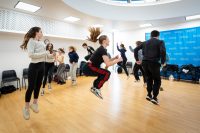
Term dates, class structure and fees
Summer term 2026
The term runs on Sundays from 4th October to the 13th Dec. There is no class on Sunday 1st Nov, due to half term.
At the last day of term, we invite family and friends (two seats per student) to join us in sharing what they have explored in the ten weeks.
The classes run on the following schedule:
Wings (age 3–4)
09:45–10:00 Registration
10:00–11:00 Class
For autumn term 2026, the fee will be £66 per term.
Upstage (age 5–6)
11:00–11:15 Registration
11:15–12:05 Class 1
12:15–13:00 Class 2
For autumn term 2026, the fee will be £126.50 per term.
Downstage (age 7–9), Centre Stage (age 10–12), Stage Left (age 13–15), Stage Right (age 14–17)
09:45–10:00 Registration
10:00–10:50 Class one
11:00–11:50 Class two
12:00–12:50 Class three
12:50–13:00 Pack up and home time
For autumn term 2026, the fee will be £154 per term.
Class structure
Wings (Ages 3–4)
Building confidence through imaginative play
Wings is a joyful first step into creativity, communication and collaboration. Through storytelling, movement, music and imaginative play, children explore how ideas become characters and how stories can be shared. They experiment with voice and physical expression, invent story worlds using colour and materials, and begin to understand simple narrative structures.
Sessions are carefully structured, nurturing and inclusive. There is no pressure to “perform well” instead, children are supported to explore, listen, take turns and grow in confidence at their own pace. In Week 10, families are invited to watch a short sharing of work, a warm, celebratory moment that builds pride and confidence.
Why it matters:
This stage develops early communication skills, imagination, coordination and social confidence, foundations that support children in all areas of learning and life.
Upstage (Ages 5–6)
Learning to collaborate and tell stories together
Upstage helps Young Artists begin shaping ideas into shared stories. Working from a termly theme, children create characters, explore simple story structures, and discover how voice, movement and design help bring ideas to life. They learn to listen, share ideas and contribute to a group creative process. Reflection is gently introduced, encouraging children to recognise what works well and how ideas can grow. The term ends with a Week 10 sharing, giving children the experience of sharing their work with focus, enjoyment and pride.
Why it matters:
Upstage supports confidence, teamwork and creative problem-solving, skills that build strong communicators and collaborators.
Downstage (Ages 7–9)
Finding your voice and taking creative ownership
Downstage is where Young Artists begin to take real ownership of their ideas. Through devising, improvisation and early script work, students collaborate to create original scenes inspired by a shared theme. They strengthen acting skills, explore stagecraft, and begin experimenting with writing dialogue and shaping stories for an audience. Students are encouraged to ask questions, take creative risks and reflect on what they are trying to communicate.
In Week 10, they share original work they have helped to create, building confidence, focus and pride.
Why it matters:
Children learn that their ideas have value, that collaboration is powerful, and that confidence grows through doing.
Center Stage (Ages 10–12)
Turning ideas into theatre.
Center Stage introduces a more structured approach to theatre-making while keeping creativity at its heart. Young Artists interpret a theme, generate ideas with intention, and collaborate to devise and write original material. They refine acting technique, develop awareness of design and staging, and begin making informed directing choices. Ensemble work is central, with students learning how to balance leadership, listening and shared responsibility. The term culminates in a Week 10 sharing, where students present confident, thoughtful work and reflect on both process and outcome.
Why it matters:
This stage builds independence, resilience, communication skills and creative confidence, essential tools for adolescence and beyond.
Stage Left (Ages 13–15)
Developing artistic identity and critical thinking
Stage Left challenges Young Artists to engage with theatre as a way of exploring ideas about the world. Students interrogate themes with greater depth, devising, writing, directing and performing original work as an ensemble. They develop advanced acting technique, apply stagecraft intentionally, and take increasing responsibility for shaping the creative process.
Critical reflection is embedded, helping young people articulate opinions, justify choices and support others’ ideas. In Week 10, students share work that demonstrates growing artistic maturity and confidence.
Why it matters:
Stage Left supports young people at a pivotal developmental stage, helping them build voice, self-belief, empathy and creative leadership.
Stage Right (Ages 14–17)
Making theatre with purpose, confidence and professionalism
Stage Right offers a rigorous, ambitious theatre-making experience for Young Artists ready to work with independence and intent. Participants develop original work through devising or writing, lead creative processes collaboratively, and apply advanced acting and stagecraft skills. Rehearsals mirror professional practice, with an emphasis on discipline, reflection and artistic clarity. Students are trusted as makers of meaning, shaping work from the ground up and supporting one another as an ensemble. Each term concludes with a Week 10 sharing, offering invaluable experience for those considering further training and powerful personal development for all.
Why it matters:
Stage Right builds confidence, resilience, leadership and a strong creative identity — skills that last far beyond the stage.
Why parents choose Young Artists
– A creative pathway from age three to eighteen
– Original work made by students
– A curriculum designed by Bristol Old Vic Theatre School staff, taught with care and ambition for each learner
– An inclusive, supportive environment with no auditions or competition
– Clear progression and a performance outcome every term
Built by Bristol Old Vic Theatre School for Young Artists.

Autumn Term 2026
Term Theme: Voices of the City
Every city has a story to tell. This term, Young Artists will explore the people, places, sounds, and stories that make Bristol unique. From its bustling harbours and colourful streets to its hidden histories and diverse communities, participants will discover how a city is shaped by the voices of those who live, work, and dream within it.
Across the ten-week term, participants will:
– Discover Bristol’s stories: Explore the city’s history, landmarks, neighbourhoods, and communities as inspiration for original theatre.
– Find their own voice: Develop characters, monologues, and performances that express different perspectives, experiences, and ideas.
– Create together: Collaborate to weave individual stories into imaginative ensemble performances inspired by the life of the city.
– Perform with confidence: Culminate in a Week 10 sharing where students participate in an original performance celebrating the many voices that make a city come alive.
“Voices of the City” is a term about listening, storytelling, and belonging, encouraging every Young Artist to explore the world around them, celebrate different perspectives, and discover how their own voice can become part of the story.

Teaching
BOVTS courses for under-18s are taught by experienced professionals, assisted by our degree students at the height of their training. All hold enhanced DBS checks.
Policy & Procedures
You can view our safeguarding policy on our Policies and Procedures page. The Young Artists Manager and Young Artists Assistant Manager oversee the smooth running of the building each Sunday.
Course Leader

-
FAQs
FAQ’s
Whether your aim is to improve your acting skills, learn a new design skill, or simply to have fun and make friends, you will receive a warm welcome at BOVTS Young Artists!
Is it for me?
BOVTS Young Artists is aimed at young people with creative spark. We aim to offer experiences in all areas of theatre making to give students an idea of how productions work in the professional world. We do this in an inclusive, fun atmosphere utilizing the talents of our current students who are soon to be professionals themselves.
Do I need any previous experience?
No, all we ask is that you are willing to give stuff a go.
Where is the course?
Classes are delivered from Bristol Old Vic Theatre School, 1-2 Downside Rd, Clifton, Bristol, BS8 2XF
Who is leading the course?
Our Young Artist Leaders and Assistants are external performing arts professionals and current BOVTS students at the height of their training.
What do I need to bring?
As the course can be fairly active, some water and a light snack is advised. We ask that crisps and crumbly foods be avoided to help maintain the cleanliness of the studios.
What do I need to wear?
There is no set uniform for BOVTS Young Artists. However, branded merchandise is available on our website. As the course is fairly active, please ensure that suitable footwear is provided. Nonrestrictive clothing, such as sports or dance wear, is also advisable to aid in free movement.
Where can i get food?
We ask that you please bring your own food and drinks. A water bottle is essential, and a nut-free snack is recommended.
What do we do?
Each term we will look at a different story or stimulus and invent a short performance around it using exercises seen on our full time courses. All students get involved with script writing, costume design, prop building, directing, stage managing and of course acting.
Will we use a script?
There may be some script or text to look at which will inspire our story. You also may be asked to write some script yourself. But mostly, we play and improvise. If working with text is a concern for you, please let us know, and we can make sure that these aspects of the classes are made accessible for you.
Do you run a financial assistance scheme?
Those who enrol on the Young Artists programme may be eligible for financial assistance through our bursary scheme. Please read our bursary policy below for further details.
-
Short Courses Refund Policy
If you wish to cancel your place on the course, you will receive a full refund if you notify the school at least 7 days prior to the start of the course. For cancellations, contact [email protected]
-
Bursaries for Youth Courses
FREQUENTLY ASKED QUESTIONS
1. When do bursary applications open for each term?
The dates for bursary applications are as follows:
Autumn term Young Conservatoire 2026 – bursary applications open between (Wednesday 27 May to Monday 10th August 2026).
Autumn term Young Artists 2026 – bursary applications are open between (Wednesday 27 May to Monday 10th August 2026).
After these dates, places will go on general sale, meaning it is still possible to enrol, but that we won’t be able to consider you for a bursary-supported place.
2. I have been allocated a bursary before, do I need to reapply for next term?
If you are currently in receipt of a bursary and your circumstances haven’t changed, you will not need to complete a bursary application form again, but you will need to let us know you wish to be considered for a bursary next term. To do this, please email [email protected] expressing your wish for your bursary to be reviewed for next term.
3. I have been allocated a bursary before, will it be the same amount if I apply again next term?
As we take on new submissions for bursaries each term, the amount you are allocated each term is liable to change. We will inform you of any changes in the amount once all bursaries have been allocated for a term.
4. I have been allocated a bursary, how long do I have before I need to let you know if I will be taking it?
You will have a period of 14 days after the bursary has been allocated to accept it.
5. I haven’t received a bursary before, how do I apply?
We will upload an application form on our website during the bursary application period. Please fill this form to be considered for a bursary.
Forms will be available in the Young Artists Bursaries section on the oldvic.ac.uk/young-artists page.
6. Will all applicants be allocated a bursary?
We will consider all applications sent via our website form and assess them against a set of criteria. However, we cannot guarantee that an applicant will be allocated a bursary.
Some of the assessment criteria we use include (but are not limited to):
> applicant in financial hardship
> disabled applicant
> applicant is from an area of low progression to higher education
> applicant is in care or is a care leaver
> applicant belongs to groups of people who are considered ‘hard to reach’If you have any further questions, please contact [email protected].
- Policies and Procedures