
Search the website
23rd February 2026
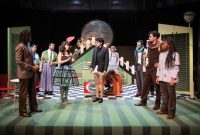
Thank you so much to everyone who came along to our BA Professional Acting second year double bill Shakespeare productions at The Station over the last fortnight.
For the accompanying freesheets, some of our MA Drama Writing students contributed programme notes for the performances. Have a read below and hope you enjoyed the shows!
MACBETH – ABBY GREENHALGH – MA DRAMA WRITING STUDENT
Macbeth is an unstoppable rollercoaster. Confronting the myths we choose to believe, and the actions we take to
prove them right, the play reminds us how easily we can all become “walking shadows” when we seek meaning in
empty promises.
With only a glimpse of power, Macbeth and Lady Macbeth propel themselves on a path towards what they believe
to be their fate. The spiralling structure of the tragedy is embraced and accelerated in this expertly abridged version.
In his own time, Shakespeare responded to mass political anxieties by turning to the individual. He explored the
psychological cost of ambition and the moral responsibility of leadership. With this in mind, Macbeth’s modern day
ramifications cannot be understated.
The play shows how personal insecurities can cause destruction and violence that impacts millions, echoing the
terrifying reality of our own global politics. Bringing to mind leaders such as Trump and Putin, Macbeth hears what
he wants to hear: tales of his own superiority. The more power he gets, the more isolated he is from anyone who
could convince him otherwise.
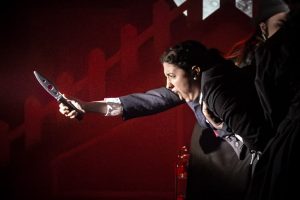
This production in particular confronts the dangers of letting rigid, dictatorial gender binaries shape our world.
Rachael Walsh’s noir-inspired take embraces the danger and brutality of Macbeth’s court, where action is the
ultimate proof of masculinity. It is the characters’ faith in prescriptive gender roles that allows a parasitic evil to take
hold and destroy society from within. Life does not “signify nothing,” rather, the characters are unable to imagine an
alternative beyond the rigid rules and expectations that govern their world.
Moments of resistance emerge however, through the playful witches and future ruler Malcolm as they embrace a
fluidity that is missing from Macbeth’s severe, black-and-white outlook. By the end of the act, we are ushered into a
brighter, freer future. The seeds are planted for the explosion of gender that occurs in Twelfth Night; a fitting foil as
one of Shakespeare’s most gender-queer plays.
Macbeth allows the talented students of Bristol Old Vic Theatre School to present an essential meditation on
morality; their emotional depth and technical precision perfectly capture the knotty mess of humanity. The show
offers a stark perspective on how the roles we feel duty-bound to perform for society can also be the things that
destroy us.
(C) Craig Fuller
TWELFTH NIGHT – EMILY DUCHEN – MA DRAMA WRITING STUDENT
Originally commissioned for Twelfth Night celebrations in 1601, Shakespeare’s play highlights theatre’s capacity for
conviviality and entertainment alongside creating a space for freedom of expression.
At its heart Twelfth Night asks what happens when we step outside the roles we are expected to play. Disguise,
transformation and joyful chaos drive the action as characters fall in love, lose themselves, and find one another again.
The world of Illyria becomes a space where rules loosen and possibility expands.
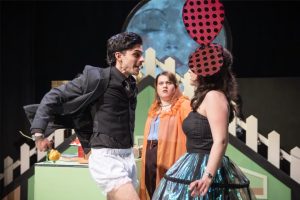
In this double bill with Macbeth, director Rachael Walsh brings a playful spin to Shakespeare’s beloved rom-com, setting
it in a retro-futuristic landscape where traditional gender roles dissolve and mischievous shenanigans ensue. This shines
through even in the repurposed costumes, playfully reimagined from their use in Macbeth. Rigid restrictions are ripped
away, transforming repression into release. Play is further emphasised in the design which introduces a fantastical
upside-down world where everyday objects are used for strange purposes including a very gripping fight with an
oversized ladle!
In 2026 where gender-based judgements still dominate and social expectations dictate much of our lives, the play
reminds us of the beauty of embracing the messy chaos that life offers, and most of all the need for fun. It invites us to
surrender control to joyful confusion. This can be seen in the scorned servant Malvolio, wrapped up in his delusions, or
the lovesick Orsino and Viola, navigating identity and desire.
Performing Shakespeare is an essential element of actor training, teaching control, tradition and emotional
understanding, learning how to transform behaviour and human emotion to prose. There is no better prose to learn
from than that of the most accomplished writer in the English language; Shakespeare’s stories remain timeless and
Twelfth Night is a celebration of humanity, inviting us to laugh and cry with the characters.
The stark contrast with Macbeth also allows the second-year students of Bristol Old Vic Theatre School to develop their
craft and understand the many facets and tones Shakespeare can take on, developing their range as actors.
‘If music be the food of love, play on’ and play on they do in this riotous production – a wild comic ride packed with joy,
excitement and the impressive talent of this next generation of actors.
(C) Craig Fuller
OTHELLO – GRACE DONALDSON – MA DRAMA WRITING STUDENT
Widely considered one of Shakespeare’s great tragedies, Othello is an all-consuming spiral of prejudice, ambition and deception.
Written in the early 1600s, it explores the destruction wrought by the racial discrimination and rigid gender roles of the
Elizabethan era. Over 400 years later, these themes still feel troublingly pertinent.
The original text reflected the racial prejudice of Shakespeare’s era, exacerbated by the Empire’s increasing financial contact with
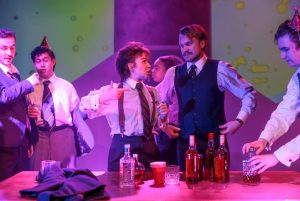
African and Mediterranean countries. By transplanting Othello from 16th century Europe to Wall Street in the 1980s, Nikhil Vyas
crafts a production sizzling with contemporary relevance. This abridged adaptation highlights just how rapidly one person’s
quest for power can spiral out of control – and how existing prejudices can be exploited to engineer utter tragedy.
The 1980s was a time of huge social change for Wall Street, as more women and individuals from the global majority were able
to obtain influence within the banking industry. Questions around who has access to money and power echo across both
periods, and linger in 2026.
Casting Iago as a woman complicates her and Othello’s respective journeys – as marginalised people attempting to thrive in the
overwhelmingly white, masculine world of finance, they face a more fraught journey than most. Vyas’s production becomes an
examination of the tough choices people on the fringe must make to be accepted by the elite.
Iago’s decision to manipulate existing prejudices against Othello in order to secure her own position in the financial hierarchy
takes on a new, tragic twist. For a queer woman to thrive in the bloody business of banking, she must be twice as Machiavellian
and scheming as her male counterparts; she must throw a fellow outsider to the wolves.
Reminiscent of popular media such as Industry and Succession, this twist on Othello reflects the complex relationship between
marginalised people and the economic elite, inviting the audience to critique biased power structures.
The rich themes of Othello allow the talented cohort at Bristol Old Vic Theatre School to breathe life into complex characters on
transformative and, in many cases, deadly – journeys. Vyas’s innovative adaptation is a nuanced, morally-grey tale that examines
the lengths people will go to obtain power – and who they’re willing to sacrifice along the way
(C) Ed Felton
THE TEMPEST – ALICE FLYNN – MA DRAMA WRITING STUDENT
Have you ever wanted to escape into the wilderness? Throw your phone off a bridge into the river and run away from the
world?
Shakespeare’s original inspiration for The Tempest was thought to be the wreck of the Sea Venture in 1609. The ship had
been carrying settlers to the new world, but was veered off course by a storm and left the passengers stranded for several
months on the then-uninhabited island of Bermuda.
Written in a time where the British empire was in its infancy, earlier productions of The Tempest would likely have framed
the story as an empowering tale of imperial prowess, love and the opportunities afforded to indigenous settlers if they
embraced this ‘brave new world’.
Nikhil Vyas’ take on The Tempest takes a darker and more nuanced approach to this traditional reading. Taking some
inspiration from the film Leave No Trace and the rise in popularity of off-grid lifestyles in the UK, Vyas’ production speaks to
the growing desire among the population to abandon our hyper-competitive, overly-digitised and increasingly surveilled
society. It asks us whether Prospero’s return to European civilisation really is such a good thing after all.
He imagines Prospero not as a wizard, but as an off-grid homesteader (with a penchant for herbal remedies) who chooses
to raise her daughter, Miranda, in the seclusion of the forest. Here, she is free to teach her own values rather than those
foisted upon those raised under Capitalism.
Presented as half of a double-bill, Vyas presents The Tempest as a mirror to the cold, chromatic, masculine, Wall Street-like
world of Othello, placing the focus on natural settings, female characters, and a lifestyle that rejects the demands of
modern capitalism, rather than embracing them.
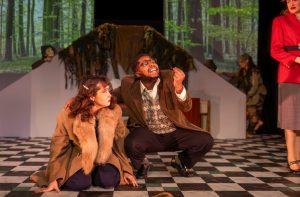
(C) Ed Felton