Search the website
28th January 2026
Since joining the School as Cultural Change Lead this time last year, thinking about the direction of travel for our EDI (Equity, Diversity and Inclusion) work at the School has been at the forefront of my mind. So I’m pleased to announce that the School has developed a strategy to take us through until the end of the 2027 academic year.
This new strategy has evolved from a year of listening and learning, working alongside our Principal, Stuart Harvey; our CEO Tom Beasley and our EDI committee.
Through informal chats with students, feedback from our LGBTQIA+, Anti-racism and Neurodiversity and Disability student groups, as well as many conversations with our brilliant staff and visiting practitioners, we’ve worked together to create something that can guide us over this next phase.
It’s a work in progress for the whole school, with some immediate, easy-win tactics, some of which are already in place, as well as some more ambitious pieces of work for us to commit to. It’s also part of an ongoing learning process; I’m sure there will be things we have missed.
And from that perspective, it’s not a fixed document. Far from it, it’s just the beginning. It will evolve as our community evolves. But what I hope is that it gives us a clearer sense of where we are heading and how we plan to get there. I also hope it will be the first iteration of something that the School continues to commit to for many years beyond 2027.
There’s no doubt that we’ve been navigating some stormy waters. The necessary transition away from our Degree programmes, alongside the work of developing new pathways for world-class training through the launch of our Foundation Courses this September 2026, has required a huge amount of collective focus and care. At the same time, the School has remained committed to ensuring that our current students continue to receive a high-quality training experience.
Equally, as the School navigates change, it does so within a wider world that is increasingly complex and fast-moving. Our students are training against a backdrop of uncertainty and economic pressure. With ongoing global struggles for equity, and at a moment when it’s easy to ignore, it now feels even more important for us to be clear about our commitment to equity, diversity, and inclusion, how we’re learning, and the steps we’ll be taking.
It strikes me that the creative industries are also shifting. There are long-overdue, yet still sometimes far too slow-moving conversations emerging around access and inclusion. Greater scrutiny of whose voices are centred and whose are still marginalised is also happening. As such, students are being asked not only to master their craft but to show up with emotional intelligence and resilience to all these factors when they graduate.
With all this in mind, having an EDI strategy for the school that enables everyone to thrive in this learning environment, whilst also equipping them for the wider world and industry, feels more important than ever.
Thank you to everyone who has supported this piece of work so far.
Please read below to learn more about our core goals for this process.
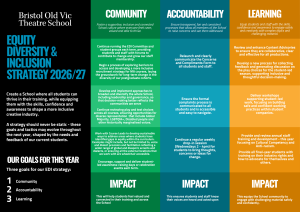
Our mission –
To create a School where all students can thrive in their training, while equipping them with the skills, confidence and awareness to shape a more inclusive creative industry.
Our Three Core Goals
1. Community
Fostering a supportive, inclusive and connected School culture where everyone feels seen, valued and able to thrive.
Training in the performing arts is deeply personal. It often calls on people to bring their full selves into the room: their bodies, identities, lived experience and their vulnerabilities. A strong sense of belonging and safety isn’t a “nice extra” – it is fundamental to our training.
Impact: A School where students feel connected, respected and able to bring their full selves into their training.
2. Accountability
Ensuring transparent, fair and consistent processes so everyone knows how to raise concerns and see them addressed.
Power, hierarchy and vulnerability often exist side by side. It is vital that students and staff know what their options are if something doesn’t feel right and that they can trust the systems designed to support them.
Impact: A culture where people feel heard, believed and supported to speak up.
3. Learning
Equipping students and staff with the skills, confidence and awareness to engage with complex material safely and creatively.
Theatre often asks us to sit with discomfort, contradiction and difficult truths. That can be powerful, but it needs to be held with care and a continual commitment to self and institution wide reflection.
Impact: A community that can engage bravely with challenging material – without people being harmed or left behind.
The infographic below details the tactics we’ll be using to achieve each of our three goals.