
Search the website
16th February 2026
BA Professional Acting 2nd Year students perform Macbeth & Twelfth Night Double Bill at The Station
Review By Kris Hallett
The Shakespeare double bills at Bristol Old Vic Theatre School are a genuinely wonderful idea. Two lean, sixty‑minute‑and‑a‑bit hits of the Bard, cracked out either side of an interval by the same repertory cast, give a whole cohort the chance to dive into big verse without wrestling with unwieldy five‑act architecture. It’s Shakespeare as sampler album, and it’s enormous fun. I enjoyed myself immensely.
Macbeth rattles through a nightmare of ambition, where a good man talks himself into murder and finds the crown far heavier than advertised. Twelfth Night, by contrast, answers with shipwrecks, disguises and the gently anarchic joy of misplaced desire. Seen together, they make a surprisingly neat pair: two plays obsessed with identity wobbling off its axis, whether scrambled by prophecy or hidden under someone else’s clothing. In this brisk, greatest‑hits format, both become clear, sharp takes on how desire trips us up, and how watchable that tumble can be.
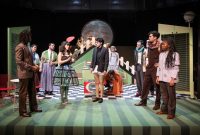
Designer Mima Jupp puts both shows on a kitchen island beneath a great looming moon: barren and grey in Macbeth, and then suddenly splashed with Warhol‑bright colour in Ilyria. Rachel Walsh’s direction clicks more confidently in the glitter‑ball world of Twelfth Night, where the reduced running time suits a story in which consequences are light and self‑reinvention is practically a sport. Her noir‑shaded Macbeth fares less well; moments that should jolt; blinds whipping open to unveil bloody ghosts or all‑seeing witches; sometimes fizzle thanks to timing snags.
Kai Freeman’s Scouse Macbeth is a compelling presence, tough enough to believe in physically but with a quiet gravity that pulls the audience in. His “tomorrow and tomorrow” finds the real poetry of the night. Lydia Hague’s Lady M opens with enormous promise, her letter scene alive with humour, irony and gorgeous command of metre held by long vowel sounds, and it feels, briefly, like we might be watching one of those legendary student performances. But the edits drain her arc a little towards the marriage collapse and her death. Walsh’s staging here feels oddly cautious: throwaway witches, undernourished battles. You start to wonder if she’s intentionally stripping things back to foreground the actors , but then Twelfth Night has a different sparkle.
That show bursts into life with a blast of “The Loco‑Motion” and Mickey Dimitrova’s lush, gender‑fluid costumes. The cuts don’t damage the comedy; if anything’s missing, it’s only a little more of Orsino’s confused attraction to his “boy.” servant Walsh nails the knockabout humour but leaves space for tenderness and melancholy to slip in. And she has, in Hari Johnson, a truly excellent Malvolio, not a fusty elder but a slightly less unhinged Basil Fawlty, all stiff-backed disdain and beautifully calibrated overreactions. It’s a hard role to pitch: too rigid and it’s dull, too silly and it collapses. Johnson threads the needle. His gulling is genuinely funny; his final vow of revenge lands with heartbreak.
Georgia Sutcliffe is a delight as Olivia, styled like a Queen of Hearts who’s just remembered she has a pulse. Her shift from mourning to appetite is played with wit and expressiveness, especially when cornering the unsuspecting Sebastian (Tyler Nazare), barking with an unsurpassed appetite. Syari‑Elise Harewood Williams anchors everything as Viola: in this gender fluid world she doesn’t need to play at being a man, a simple removal of her glasses reveals her true self, like Christopher Reeve taking off his Clark Kent specs.
Taken together, these productions show the School’s ambition and the cast’s ability to stretch themselves across wildly different tones, even when the cuts occasionally pull against them. There’s imagination, curiosity, and a real sense of discovery throughout. It’s not flawless , nor should it be with second year students, but it’s engaging, inventive work, and a reminder of why Shakespeare remains such rich, generous training ground.