
Search the website
18th March 2026
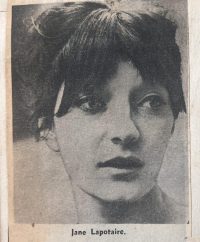
Jane Lapotaire – ‘There’s a great spirit gone’. Shakespeare (Antony and Cleopatra)
I had the privilege of directing my fellow Bristol Old Vic Theatre School graduate, Jane Lapotaire in my very first Shakespeare production for the RSC. It was Henry VIII or All is True (the subtitle we chose to use). Jane would play the role of Queen Katherine of Aragon opposite Paul Jesson as the King. The (then) Artistic Director, Adrian Noble, had given me sage advice: ‘Cast the very best people you can. Don’t be tempted just to cast your friends, cast people who are better than you, and they will make you better’.
Well there was no question of that. Jane Lapotaire was legendary at the RSC. She had recently played Gertrude to Ken Branagh’s Hamlet and Mrs Alving in Ghosts for Katie Mitchell. But I remembered her as Piaf, her astonishingly raw performance in Pam Gem’s play about the Parisian ‘Sparrow’, the chanteuse, Édith Piaf. And I remember her playing a gloriously witty Rosaline in Love’s Labour’s Lost for John Barton, with whom we shared a lifelong friendship.
But during Henry VIII I learnt a very key lesson from Jane about directing.
Cardinal Wolsey was played by the great Ian Hogg. Ian is from the North East, and had trained at the Central school. They both had very different approaches to acting. To both, rehearsal was about exploring. But there came a point when Jane wanted to settle and to fix. Whereas Ian was not content until he had understood the whole role, had absorbed the real meaning of what he was saying and why he was saying it. So he would keep the scenes very fluid.
Tension threatened to arise. Both actors would look at me.
I realised that the job of the director is to accommodate every actors’ method of working and to find a shared vocabulary. Diplomacy, someone once said, is the art of telling someone to go to hell in such a way that they look forward to the trip. I was lucky, both Ian and Jane were generous enough, and professional enough, not to put this young director’s diplomatic skills to the test. We evolved a very open approach, really listening and understanding what each actor needed to produce their best work. It was a very happy rehearsal period, Ian and Jane ended up with deep respect and love for each other. I can remember details of their performances to this day.
Jane suffered a terrible cerebral haemorrhage later in her career, and thought she would never work on stage again. I tempted her back to the company she loved, when I took over the RSC in 2012. She accepted the role of The Duchess of Gloucester in Richard II (with David Tennant as the King). It’s one scene, right at the start of the play, it explains some very tricky back story. But playing opposite Michael Pennington as John of Gaunt, Jane turned the role of the mourning widow not only into a paean of grief, but a woman with a burning appetite for revenge.
When I completed the history cycle with Henry V in 2015, Jane bookended the tetralogy with a virtuoso performance as Isabel, Queen of France (I had incorporated the roles of the Queen and Duke of Burgundy together for her).
Jane overcame so much in her life, with tenacity and resilience. The book she wrote about her brain haemorrhage was titled, very wittily, ‘Time Out of Mind’. When she was honoured by the King in February earlier this year, she told me CBE stood for ‘Conquered Brain Embolism’ ( or ‘Can’t Be Employed’!)
I shall miss her deeply.
Greg Doran
March 2026
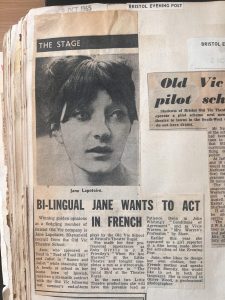
This press cutting was discovered in the BOVTS Archive from an original 1966 article in a newspaper.